All blockchains struggle to balance decentralization, security, and scalability at the same time in what is commonly called the blockchain trilemma. When many independent validators verify transactions, the network becomes more decentralized and secure, but coordinating all of them takes time and slows throughput. Reduce the validator set to move faster, and decentralization becomes the trade-off.
Enter Monad, a Layer-1 blockchain that tries to overcome this trilemma at scale. Rather than treating the limitation as an unavoidable rule, Monad treats it as an architectural problem and redesigns how the Ethereum Virtual Machine executes transactions.
Ethereum prioritizes decentralization and security, but that comes with congestion and high fees during heavy demand. Solana pushes toward speed and performance, but that has historically come with trade-offs such as outages and a validator environment that is harder to keep broadly distributed.
Monad's premise is straightforward: aim for Ethereum-level decentralization at Solana-level speed, without forcing developers to abandon the EVM or rewrite their smart contracts.
What is Monad Blockchain?
Monad is a high-performance Layer-1 blockchain with full EVM compatibility. In practical terms, developers can build, port, or run Ethereum dApps and smart contracts on Monad without code changes.
Its core breakthrough is parallel execution. Instead of lining transactions up one by one, Monad can process many of them simultaneously, which allows the network to stay fast even when usage rises.
Monad is notable because it keeps Ethereum bytecode compatibility while also executing transactions in parallel and pipelining block production. It is trying to scale the EVM itself, not scale around it.
Built from scratch with systems-level performance in mind, Monad is designed to combine Ethereum-grade security and decentralization with very high throughput, sub-second finality, and extremely low fees.
How Does Monad Network Work?
Every blockchain does two fundamental jobs. First is consensus, which is agreeing on the order of transactions in the ledger. Second is execution, which is applying those transactions so balances and smart-contract state actually change.
On Ethereum, once consensus is known, the EVM executes transactions one by one. Even if a machine has many CPU cores available, only a single transaction is typically running at a given moment. That is one of the reasons busy periods lead to slowdowns and high fees.
Monad changes the execution stage. Once transaction order is agreed, the network runs many transactions in parallel across available CPU cores, and then applies results in the exact agreed order so every node reaches the same final state without having to run everything sequentially.
The outcome is familiar EVM semantics with much higher throughput.
- Ethereum: consensus -> execution -> consensus -> execution, in a serial single-threaded flow.
- Monad: consensus and execution overlap, with multi-core parallel execution across the transaction set.
Parallel Execution Explained
There are two broad ways to speed up an EVM chain. One is sharding, which splits the network into separate pieces that process transactions independently. That can improve scalability, but it also fragments blockspace and adds complexity.
The other is parallel execution. This keeps one unified blockspace while processing many transactions simultaneously, increasing throughput without splitting the network into separate shards.
- Sharding increases throughput by splitting work across shards, but adds fragmentation and operational complexity.
- Parallel execution keeps one blockspace and boosts throughput by using available compute more efficiently.
- Monad can re-execute conflicting transactions when needed instead of sacrificing validator participation or relying on extreme hardware requirements.
Monad also pipelines block production. While block N is being executed, block N+1 can already be progressing through consensus. That overlap reduces waiting time between stages and further improves throughput and finality.
Monad's core idea is not to sidestep the EVM, but to make the EVM itself fast enough to compete with high-performance chains.
Put together, parallel execution inside each block and pipelining between blocks is what allows Monad to push toward high throughput while preserving decentralization and EVM compatibility.
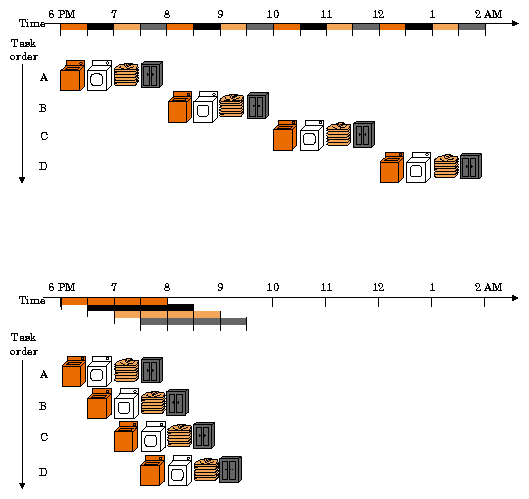
Comparison of linear vs parallel task processing: the simple intuition is that one system runs chores one by one, while the other can run many chores simultaneously without changing the final order of completion.
Monad’s Other Architectural Components
Monad’s performance comes from several systems working together, not from parallel execution alone.
- MonadBFT: a fast and fork-resistant consensus design that finalizes blocks in under a second even with a broad validator set.
- RaptorCast: a networking layer that distributes blocks quickly across validators so the network stays in sync without requiring everyone to sit in the same data center.
- Asynchronous Execution: the network agrees on transaction order first and executes afterward, so execution does not slow block finalization.
- MonadDb: a storage engine built for fast reads and writes as the chain scales with more users and applications.
Monad Tokenomics: Explained
Monad has a fixed total supply of 100 billion MON, distributed across the groups intended to support network growth.
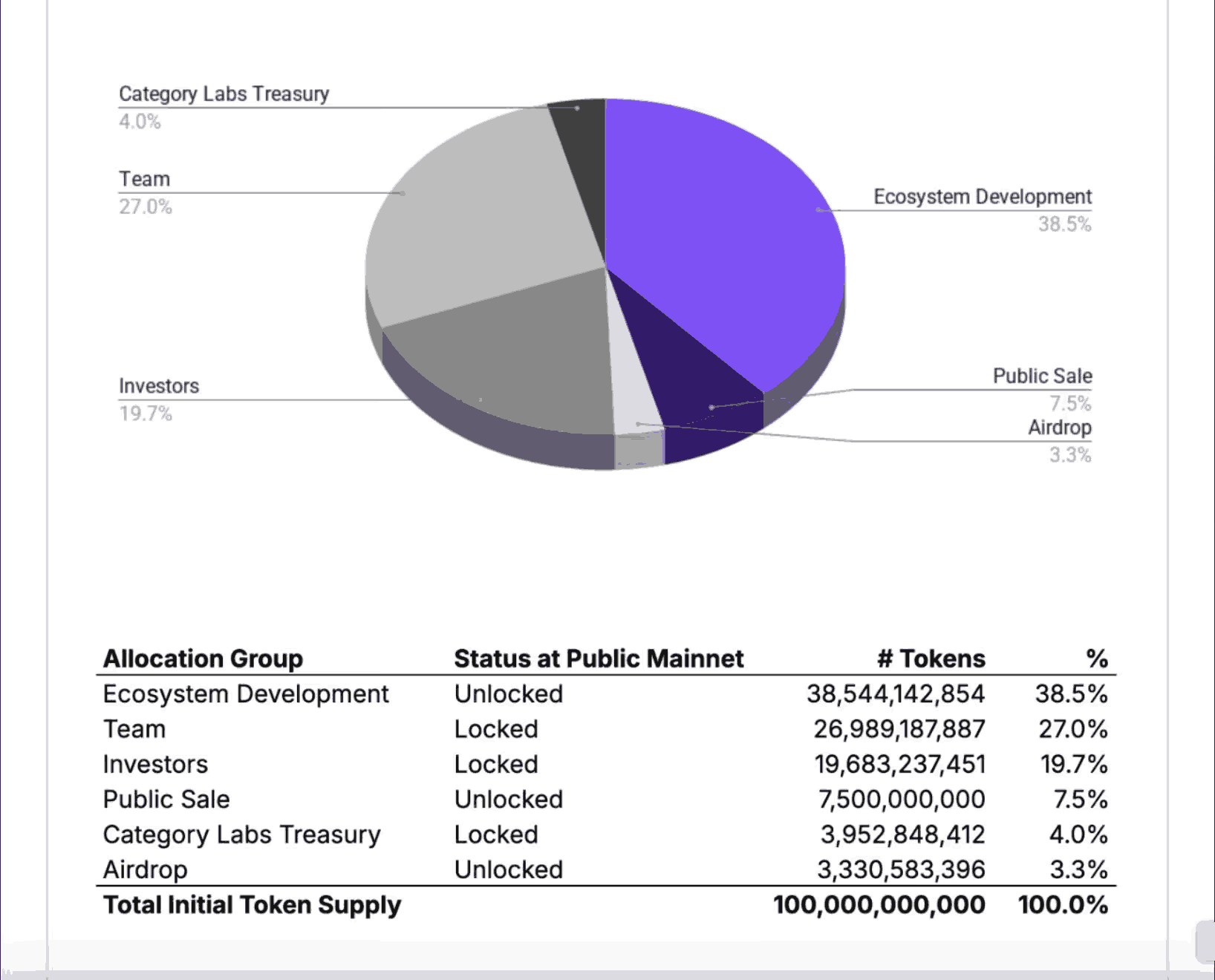
Unlike many token launches, Monad did not run a traditional ICO. It instead released MON during its mainnet Token Generation Event in November 2025. Early excitement was helped by Coinbase-related sale activity and active pre-market trading before full mainnet usage arrived.
As of the time of writing, MON trades around the $0.03 range, below its earlier peak, while the market waits to see whether real usage can continue after early incentive programs fade.
Monad Crypto Native Token: MON
The Monad network’s native token MON is required for activity across the chain and serves three main functions.
- Gas fees: MON pays for transactions and smart-contract execution, while network efficiency keeps fees very low.
- Staking and security: Monad uses Proof-of-Stake, so token holders can stake or delegate MON to help secure the network and earn rewards.
- Ecosystem currency: MON acts as the base asset and primary settlement token across DeFi, NFTs, lending, and other apps.
MON follows a dual issuance-and-burn model. New MON is issued to validators and delegators, while the base transaction fee is permanently burned. Locked allocations for team members, investors, and the treasury are excluded from staking rewards so insiders do not earn passive yield on unvested tokens.
In practice, stakers earn at roughly the same pace that new tokens are created, which reduces dilution pressure for active participants. Over time, the plan is for network fees to take over more of the system’s economics so inflation can matter less.
Benefits & Use Cases of Monad
Monad’s main advantages come directly from its architectural design choices.
Scalability Without Fragmentation
DeFi apps such as DEXs, lending markets, perpetuals, and liquid staking protocols can live in the same shared environment without fragmenting liquidity across shards. Trades, liquidations, and lending flows can feel closer to centralized exchange speed without the same gas spikes and failed transactions seen on congested chains.
That same speed also matters for gaming, where real-time interactions, asset transfers, and player economies become more practical when latency and fees stay low.
The same architectural gains could also matter for larger digital economies and institutional settlement of tokenized real-world assets such as stocks and bonds.
High Performance Without Specialty Hardware
Monad’s goal is to let validators run with consumer-grade hardware rather than only data-center-grade machines. That matters because validator accessibility affects how broadly decentralized the chain can remain.
Developer Familiarity
Full EVM compatibility means Solidity contracts, tooling, wallets, and workflows can carry over with minimal friction.
Fast Finality
Blocks finalize in under a second because execution does not hold back consensus. For users, that means trades settle quickly and NFT or app interactions feel near-instant even during heavier demand.
For institutions, faster finality improves the case for onchain settlement of tokenized assets without long confirmation delays.
Future-Proof Execution Model
Monad is designed for workloads that would overwhelm many current Layer-1 chains, including real-time games, social applications with large onchain message volume, and high-frequency DeFi.
Is Monad The Future of L1s in Crypto?
On paper, Monad targets around 10,000 transactions per second, roughly 400 ms block times, and about 800 ms finality. That places it well ahead of typical EVM chains in raw throughput and latency.
Before launch, Monad was discussed around a valuation near $3 billion. It then launched public mainnet in November 2025 alongside the Token Generation Event for MON, with a total supply of 100 billion tokens.
Monad has already handled meaningful activity, including millions of transactions around launch, short bursts above 350 TPS during memecoin speculation, and rapid early DeFi TVL growth. That does not prove long-term dominance, but it does show the chain can handle real demand.
Monad Today and Into the Future
Monad is already seeing real traffic, and its current performance profile broadly matches the high-speed EVM thesis behind its architecture.
It is not the only chain pursuing parallelized EVM execution. Sei v2 and MegaETH are also contenders. But Monad currently stands out for combining full Ethereum bytecode compatibility, aggressive pipelining, and sub-second finality on an independent Layer-1.
The real test is whether Monad can sustain adoption once incentives fade and real economic activity becomes the main source of demand.
FAQ
1. Is Monad built on Ethereum? No. Monad is an independent Layer-1 blockchain that supports the Ethereum Virtual Machine, so Ethereum smart contracts can run on it without modification.
2. Can you invest in Monad (MON)? Yes. MON is available to buy, and self-custody remains the safer way to hold it if you want control over your keys.
3. How secure is Monad crypto? Monad is designed to preserve Ethereum-level decentralization and security with a globally distributed validator set. Because the network is still early, its long-term security will depend on validator distribution, stake concentration, and real-world resilience over time.